 IncomeWiki
Revision 2
Threads Growth Strategy: How to Grow Your Followers and Build an Audience
@namkyu · Nov 20, 2026, 7:34 AM
No edit summary
Threads is a text-focused social media platform where people share ideas, exchange opinions, and build connections through conversations.
For creators, entrepreneurs, and solopreneurs, Threads can be a useful channel for sharing expertise, documenting progress, building an audience, and connecting with potential customers.
However, growing an account involves more than simply publishing posts every day. Content topics, opening lines, audience engagement, profile optimization, and consistency all play important roles.
This guide explores practical strategies for growing on Threads, improving engagement, and turning casual readers into long-term followers.
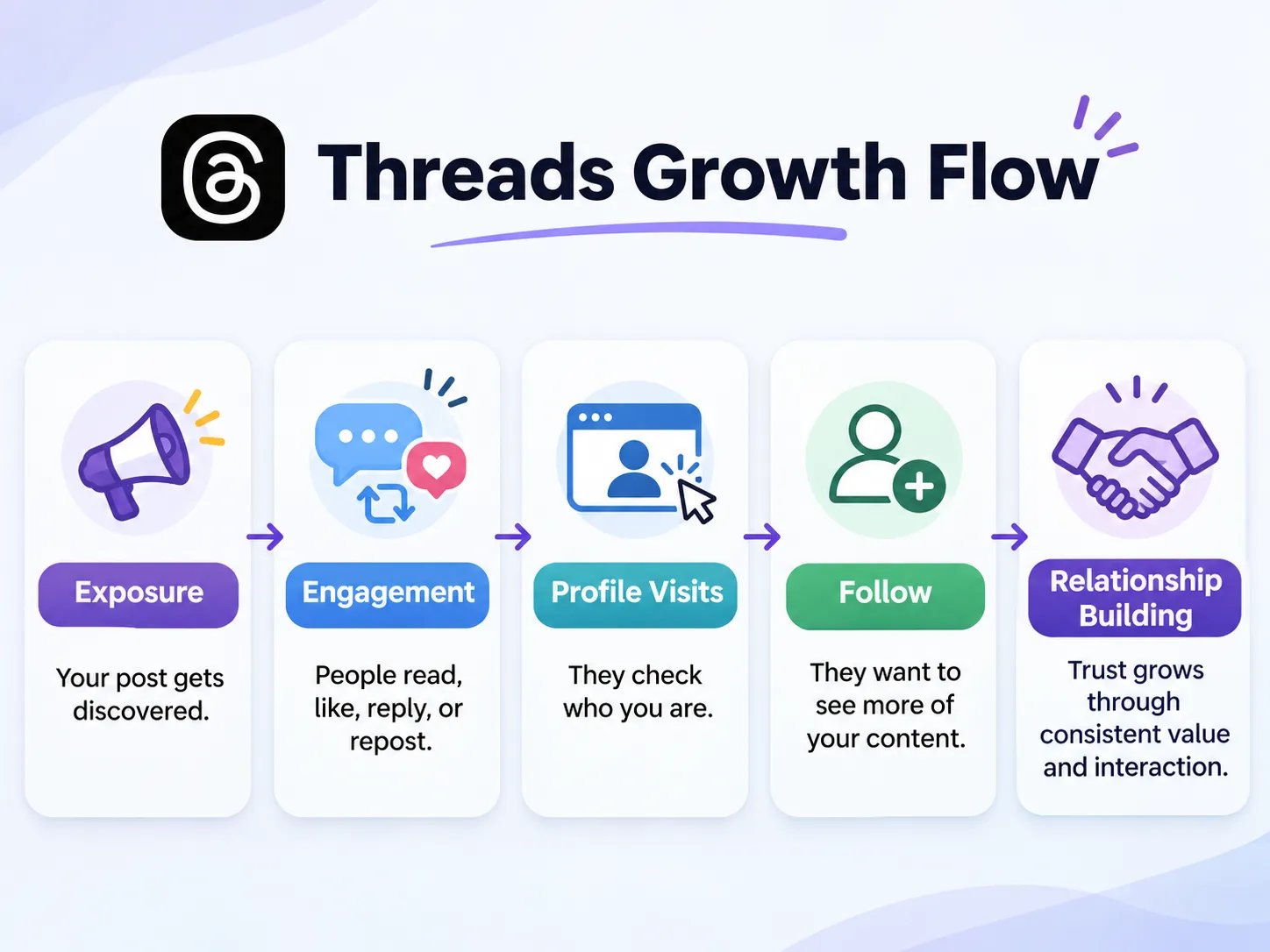
Growing a Threads account can be understood as a series of stages:
Exposure → Engagement → Profile Visits → Follows → Relationship Building
Each stage represents a different part of the audience growth process.
Exposure: Your content reaches people who may not know you yet.
Engagement: People read, like, reply to, or repost your content.
Profile Visits: Interested readers visit your profile to learn more about you.
Follows: People decide they want to see more of your content.
Relationship Building: Consistent interactions and useful content help develop trust over time.
A post with thousands of views does not necessarily generate hundreds of followers.
A viral post may attract temporary attention, while a consistent stream of relevant content gives people a reason to follow your account.
The goal is not just to maximize exposure, but to attract people who are genuinely interested in what you share.
One of the most important steps in growing an audience is defining what your account is about.
Canonical Markdown
 Threads is a text-focused social media platform where people share ideas, exchange opinions, and build connections through conversations. For creators, entrepreneurs, and solopreneurs, Threads can be a useful channel for sharing expertise, documenting progress, building an audience, and connecting with potential customers. However, growing an account involves more than simply publishing posts every day. Content topics, opening lines, audience engagement, profile optimization, and consistency all play important roles. This guide explores practical strategies for growing on Threads, improving engagement, and turning casual readers into long-term followers. ## Understanding How Threads Growth Works Growing a Threads account can be understood as a series of stages: **Exposure → Engagement → Profile Visits → Follows → Relationship Building** Each stage represents a different part of the audience growth process. - **Exposure:** Your content reaches people who may not know you yet.- **Engagement:** People read, like, reply to, or repost your content.- **Profile Visits:** Interested readers visit your profile to learn more about you.- **Follows:** People decide they want to see more of your content.- **Relationship Building:** Consistent interactions and useful content help develop trust over time. A post with thousands of views does not necessarily generate hundreds of followers. A viral post may attract temporary attention, while a consistent stream of relevant content gives people a reason to follow your account. The goal is not just to maximize exposure, but to attract people who are genuinely interested in what you share.  ## Establishing Your Content Strategy and Account Identity One of the most important steps in growing an audience is defining what your account is about. When people visit your profile, they should quickly understand what kind of content they can expect. For example: - **Entrepreneurs:** Business ideas, startup experiences, failures, lessons, and growth strategies.- **Developers:** Technical insights, development processes, projects, and tools.- **Creators:** Content production, audience growth, monetization, and creative workflows.- **Marketers:** Marketing experiments, case studies, analytics, and practical strategies. This does not mean you must talk about only one topic. Instead, your content should revolve around a consistent identity that connects different subjects. ### The 70/20/10 Content Approach A possible starting framework is: <!-- incomewiki-layout:v1:%7B%22block%22%3A%22table%22%2C%22nodes%22%3A%5B%7B%22type%22%3A%22table%22%2C%22rows%22%3A%5B%5B%7B%22type%22%3A%22tableHeader%22%2C%22colspan%22%3A1%2C%22rowspan%22%3A1%2C%22colwidth%22%3Anull%2C%22align%22%3Anull%7D%2C%7B%22type%22%3A%22tableHeader%22%2C%22colspan%22%3A1%2C%22rowspan%22%3A1%2C%22colwidth%22%3Anull%2C%22align%22%3Anull%7D%2C%7B%22type%22%3A%22tableHeader%22%2C%22colspan%22%3A1%2C%22rowspan%22%3A1%2C%22colwidth%22%3Anull%2C%22align%22%3Anull%7D%5D%2C%5B%7B%22type%22%3A%22tableCell%22%2C%22colspan%22%3A1%2C%22rowspan%22%3A1%2C%22colwidth%22%3Anull%2C%22align%22%3Anull%7D%2C%7B%22type%22%3A%22tableCell%22%2C%22colspan%22%3A1%2C%22rowspan%22%3A1%2C%22colwidth%22%3Anull%2C%22align%22%3Anull%7D%2C%7B%22type%22%3A%22tableCell%22%2C%22colspan%22%3A1%2C%22rowspan%22%3A1%2C%22colwidth%22%3Anull%2C%22align%22%3Anull%7D%5D%2C%5B%7B%22type%22%3A%22tableCell%22%2C%22colspan%22%3A1%2C%22rowspan%22%3A1%2C%22colwidth%22%3Anull%2C%22align%22%3Anull%7D%2C%7B%22type%22%3A%22tableCell%22%2C%22colspan%22%3A1%2C%22rowspan%22%3A1%2C%22colwidth%22%3Anull%2C%22align%22%3Anull%7D%2C%7B%22type%22%3A%22tableCell%22%2C%22colspan%22%3A1%2C%22rowspan%22%3A1%2C%22colwidth%22%3Anull%2C%22align%22%3Anull%7D%5D%2C%5B%7B%22type%22%3A%22tableCell%22%2C%22colspan%22%3A1%2C%22rowspan%22%3A1%2C%22colwidth%22%3Anull%2C%22align%22%3Anull%7D%2C%7B%22type%22%3A%22tableCell%22%2C%22colspan%22%3A1%2C%22rowspan%22%3A1%2C%22colwidth%22%3Anull%2C%22align%22%3Anull%7D%2C%7B%22type%22%3A%22tableCell%22%2C%22colspan%22%3A1%2C%22rowspan%22%3A1%2C%22colwidth%22%3Anull%2C%22align%22%3Anull%7D%5D%5D%2C%22index%22%3A0%7D%5D%7D --> | Content Type | Ratio | Examples || ------------------------ | ----- | -------------------------------------------------------- || Core Topics | 70% | Educational content, tips, guides, and insights || Experiences and Progress | 20% | Achievements, failures, experiments, and lessons learned || Personal Stories | 10% | Daily experiences, reflections, and conversations | For example, an entrepreneur might primarily share business insights while occasionally discussing personal challenges or daily experiences. These percentages are not official Threads algorithm recommendations. They are simply a framework that can help maintain a consistent content direction. The best balance depends on your audience, goals, and content performance. ## Writing Better Hooks: The First Sentence Matters Threads users scroll through a continuous feed of short posts. This makes the opening sentence especially important. A strong opening, often called a *hook*, gives readers a reason to stop scrolling and continue reading. Here are five approaches. ### Contrarian Hooks Challenge a common assumption or introduce an unexpected perspective. **Example:** > I started a business and learned something unexpected: building the product was easier than getting people to notice it. Contrarian hooks work best when they introduce a genuine insight rather than creating controversy for attention. ### Number-Based Hooks Use specific numbers, periods, or measurable outcomes. **Example:** > 5 lessons I learned from spending 3 months building a SaaS product alone. Numbers can make a topic feel more concrete and help readers understand what to expect. However, they should reflect real experiences or verifiable information rather than invented results. ### Problem-Focused Hooks Highlight a problem your target audience might recognize. **Example:** > What's the biggest mistake solo founders make when building their first SaaS? This approach works particularly well for educational posts that offer practical solutions. ### Personal Experience Hooks Start with something you have personally experienced. **Example:** > When I started building my first business, I thought a good product would naturally attract users. I was wrong. Personal stories can make content more relatable and distinguish it from generic advice. ### Question-Based Hooks Invite people to share their own experiences or opinions. **Example:** > What's the hardest part of running a business alone: building, marketing, or staying consistent? Questions can encourage discussion when they are relevant to the interests of your audience. **The main principle is simple: give people a clear reason to keep reading.** A good hook creates interest without making misleading promises. ## Content Types That Encourage Engagement Different content formats can attract different kinds of attention. Understanding these formats helps create a more balanced content strategy. ### Educational Content Educational posts share information that readers can apply. Examples include: - Step-by-step tutorials- Useful tools and resources- Practical marketing techniques- Business frameworks- Common mistakes and solutions The most useful educational content helps readers solve a specific problem. ### Personal Experiences and Lessons Sharing your journey can make your content more distinctive. Successful outcomes can be inspiring, but failures and unexpected problems can be equally valuable. A useful structure is: **What I tried → What happened → What I learned** For example, instead of simply saying that marketing is difficult, explain which marketing methods you tried and what results you observed. Specific experiences often provide more value than general statements. ### Opinion-Based Content Sharing personal perspectives can encourage discussion. You might discuss: - Whether subscription-based SaaS is better than one-time purchases- The advantages and disadvantages of building with AI- Common misconceptions about entrepreneurship- Different approaches to finding early customers Opinions do not need to be universally accepted. However, explaining the reasoning behind your perspective makes the discussion more meaningful. ### Conversation and Question Posts Some posts are designed primarily to encourage discussion. For example: > Solo founders: how did you find your first customer? A relevant question can attract people with similar interests and create opportunities for genuine conversations. Avoid asking questions purely to generate artificial engagement. The best conversations provide value to both the author and the participants. ## Using Comments to Build Your Audience Publishing your own posts is only one part of growing on Threads. Participating in conversations on other people's posts can also help new readers discover your account. More importantly, it helps you build relationships within your area of interest. ### A Practical Comment Strategy 1. Find accounts that regularly discuss topics relevant to your audience.2. Read their posts carefully before responding.3. Share a useful opinion, experience, or additional insight.4. Ask thoughtful follow-up questions when appropriate.5. Continue conversations and build relationships over time. For example, imagine someone announces the launch of a new SaaS product. A generic response might be: > Great product! Good luck! A more meaningful response might be: > Congrats on the launch! I'm building a product too, and finding early users has been challenging. How did you find your first customers? The second response introduces a shared experience and creates an opportunity for conversation. ### Focus on Meaningful Engagement Repeated generic comments, aggressive self-promotion, and follow-for-follow requests may increase activity without creating a genuinely interested audience. Instead, focus on conversations with people who share your interests or could benefit from your content. **A small network of meaningful connections can be more valuable than a large audience with little interest in your work.** ## Optimizing Your Profile for Follower Conversion When someone discovers an interesting post, they may visit the author's profile before deciding whether to follow. Your profile should quickly answer four questions: 1. Who are you?2. What do you do or know?3. What can followers expect from your content?4. Why should someone follow you? ### Writing a Clear Bio A useful profile description typically combines identity, interests, and value. **Example for a solopreneur:** > Building businesses from scratch. Sharing startup experiments, lessons learned, and practical growth strategies. **Example for a developer:** > Building products with code and AI. Sharing development insights, experiments, and lessons from shipping real projects. Your bio does not need to exaggerate your achievements. An honest description of what you are building and learning can be compelling, especially when your audience is interested in the process. ### Use Pinned Posts Pinned posts can introduce your account to new visitors. Consider pinning content that explains: - Who you are- What you are working on- What topics you regularly discuss- What followers can expect in the future A pinned introduction can help turn an interesting individual post into a longer-term connection. ## Posting Frequency and Daily Routines Consistency can help maintain audience interest and provide more opportunities to learn what works. However, posting frequently does not automatically guarantee growth. Content quality, relevance, and sustainability also matter. ### Starting With 1–3 Posts per Day One possible approach is to publish one to three posts daily while testing different content types. For example: <!-- incomewiki-layout:v1:%7B%22block%22%3A%22table%22%2C%22nodes%22%3A%5B%7B%22type%22%3A%22table%22%2C%22rows%22%3A%5B%5B%7B%22type%22%3A%22tableHeader%22%2C%22colspan%22%3A1%2C%22rowspan%22%3A1%2C%22colwidth%22%3Anull%2C%22align%22%3Anull%7D%2C%7B%22type%22%3A%22tableHeader%22%2C%22colspan%22%3A1%2C%22rowspan%22%3A1%2C%22colwidth%22%3Anull%2C%22align%22%3Anull%7D%2C%7B%22type%22%3A%22tableHeader%22%2C%22colspan%22%3A1%2C%22rowspan%22%3A1%2C%22colwidth%22%3Anull%2C%22align%22%3Anull%7D%5D%2C%5B%7B%22type%22%3A%22tableCell%22%2C%22colspan%22%3A1%2C%22rowspan%22%3A1%2C%22colwidth%22%3Anull%2C%22align%22%3Anull%7D%2C%7B%22type%22%3A%22tableCell%22%2C%22colspan%22%3A1%2C%22rowspan%22%3A1%2C%22colwidth%22%3Anull%2C%22align%22%3Anull%7D%2C%7B%22type%22%3A%22tableCell%22%2C%22colspan%22%3A1%2C%22rowspan%22%3A1%2C%22colwidth%22%3Anull%2C%22align%22%3Anull%7D%5D%2C%5B%7B%22type%22%3A%22tableCell%22%2C%22colspan%22%3A1%2C%22rowspan%22%3A1%2C%22colwidth%22%3Anull%2C%22align%22%3Anull%7D%2C%7B%22type%22%3A%22tableCell%22%2C%22colspan%22%3A1%2C%22rowspan%22%3A1%2C%22colwidth%22%3Anull%2C%22align%22%3Anull%7D%2C%7B%22type%22%3A%22tableCell%22%2C%22colspan%22%3A1%2C%22rowspan%22%3A1%2C%22colwidth%22%3Anull%2C%22align%22%3Anull%7D%5D%2C%5B%7B%22type%22%3A%22tableCell%22%2C%22colspan%22%3A1%2C%22rowspan%22%3A1%2C%22colwidth%22%3Anull%2C%22align%22%3Anull%7D%2C%7B%22type%22%3A%22tableCell%22%2C%22colspan%22%3A1%2C%22rowspan%22%3A1%2C%22colwidth%22%3Anull%2C%22align%22%3Anull%7D%2C%7B%22type%22%3A%22tableCell%22%2C%22colspan%22%3A1%2C%22rowspan%22%3A1%2C%22colwidth%22%3Anull%2C%22align%22%3Anull%7D%5D%5D%2C%22index%22%3A0%7D%5D%7D --> | Time | Content Type | Purpose || --------- | ---------------------------------------- | -------------------------------- || Morning | Personal experiences or reflections | Build familiarity and connection || Afternoon | Questions, opinions, or discussions | Encourage engagement || Evening | Educational content or detailed insights | Demonstrate value and expertise | These time slots are examples, not universally optimal posting times. The ideal schedule depends on when your audience is active and how your content performs. ### A Simple Daily Routine An example 60-minute routine: - **10 minutes:** Publish or prepare content.- **20 minutes:** Respond to comments and ongoing conversations.- **30 minutes:** Read and meaningfully engage with relevant accounts. This routine can be adjusted based on your available time. A sustainable schedule is generally more useful than an aggressive routine that becomes difficult to maintain. ## Measuring Growth and Improving Your Strategy Follower count is an important metric, but it does not tell the whole story. Depending on your goals, you may want to measure several different indicators. <!-- incomewiki-layout:v1:%7B%22block%22%3A%22table%22%2C%22nodes%22%3A%5B%7B%22type%22%3A%22table%22%2C%22rows%22%3A%5B%5B%7B%22type%22%3A%22tableHeader%22%2C%22colspan%22%3A1%2C%22rowspan%22%3A1%2C%22colwidth%22%3Anull%2C%22align%22%3Anull%7D%2C%7B%22type%22%3A%22tableHeader%22%2C%22colspan%22%3A1%2C%22rowspan%22%3A1%2C%22colwidth%22%3Anull%2C%22align%22%3Anull%7D%5D%2C%5B%7B%22type%22%3A%22tableCell%22%2C%22colspan%22%3A1%2C%22rowspan%22%3A1%2C%22colwidth%22%3Anull%2C%22align%22%3Anull%7D%2C%7B%22type%22%3A%22tableCell%22%2C%22colspan%22%3A1%2C%22rowspan%22%3A1%2C%22colwidth%22%3Anull%2C%22align%22%3Anull%7D%5D%2C%5B%7B%22type%22%3A%22tableCell%22%2C%22colspan%22%3A1%2C%22rowspan%22%3A1%2C%22colwidth%22%3Anull%2C%22align%22%3Anull%7D%2C%7B%22type%22%3A%22tableCell%22%2C%22colspan%22%3A1%2C%22rowspan%22%3A1%2C%22colwidth%22%3Anull%2C%22align%22%3Anull%7D%5D%2C%5B%7B%22type%22%3A%22tableCell%22%2C%22colspan%22%3A1%2C%22rowspan%22%3A1%2C%22colwidth%22%3Anull%2C%22align%22%3Anull%7D%2C%7B%22type%22%3A%22tableCell%22%2C%22colspan%22%3A1%2C%22rowspan%22%3A1%2C%22colwidth%22%3Anull%2C%22align%22%3Anull%7D%5D%2C%5B%7B%22type%22%3A%22tableCell%22%2C%22colspan%22%3A1%2C%22rowspan%22%3A1%2C%22colwidth%22%3Anull%2C%22align%22%3Anull%7D%2C%7B%22type%22%3A%22tableCell%22%2C%22colspan%22%3A1%2C%22rowspan%22%3A1%2C%22colwidth%22%3Anull%2C%22align%22%3Anull%7D%5D%2C%5B%7B%22type%22%3A%22tableCell%22%2C%22colspan%22%3A1%2C%22rowspan%22%3A1%2C%22colwidth%22%3Anull%2C%22align%22%3Anull%7D%2C%7B%22type%22%3A%22tableCell%22%2C%22colspan%22%3A1%2C%22rowspan%22%3A1%2C%22colwidth%22%3Anull%2C%22align%22%3Anull%7D%5D%2C%5B%7B%22type%22%3A%22tableCell%22%2C%22colspan%22%3A1%2C%22rowspan%22%3A1%2C%22colwidth%22%3Anull%2C%22align%22%3Anull%7D%2C%7B%22type%22%3A%22tableCell%22%2C%22colspan%22%3A1%2C%22rowspan%22%3A1%2C%22colwidth%22%3Anull%2C%22align%22%3Anull%7D%5D%5D%2C%22index%22%3A0%7D%5D%7D --> | Metric | What It Measures || --------------------------- | ------------------------------------------------- || Post Views | How widely your content is being seen || Likes, Replies, and Reposts | How people interact with your content || Profile Visits | Interest in learning more about you || Follower Growth | Changes in your ongoing audience || Link Clicks | Traffic directed to external websites || Signups and Conversions | Business outcomes generated through your audience | For creators, engagement and audience growth may be primary goals. For entrepreneurs, website visits, product signups, and customer relationships can be equally important. ### Analyzing Successful Posts When a post performs well, consider: - What was the topic?- How was the opening sentence written?- Was it educational, personal, or opinion-based?- Did readers ask questions or share experiences?- Did it attract the kind of audience you want? You can then revisit successful topics from different angles. For example, a post about finding early customers could become a series about outreach methods, failures, experiments, and practical lessons. ### Avoid Confusing Correlation With Causation Suppose you publish a marketing post and gain 20 followers that day. The increase may be related to the post, but it could also reflect earlier content, profile visits, other conversations, or unrelated exposure. Tracking publishing activity alongside performance helps identify patterns, but it does not automatically establish what caused the growth. This distinction is especially important when evaluating marketing experiments. ## My Perspective: Meaningful Connections Matter More Than Follower Counts *The following section reflects the author's personal perspective.* I believe the most valuable part of growing a social media audience is not simply increasing follower numbers. It is connecting with people who genuinely care about the topics you discuss. This is especially important for entrepreneurs and solopreneurs. An account might have thousands of followers, but if those people have little interest in the business or product being developed, the audience may contribute very little to actual business growth. On the other hand, a smaller audience consisting of founders, potential customers, creators, and people facing similar challenges may lead to more meaningful opportunities. For that reason, I think social media growth should be evaluated using more than just views and followers. It is also worth considering: - Who is engaging with your content?- Are you building relationships with relevant people?- Are conversations leading to useful feedback?- Are people becoming interested in your projects or products?- Is your audience helping you learn, improve, or discover new opportunities? For someone building a business, meaningful relationships may ultimately matter more than vanity metrics. ## Key Takeaways Growing on Threads requires more than posting frequently or chasing viral content. A practical growth strategy includes: 1. **Define your identity.** Make it clear what your account is about.2. **Write stronger hooks.** Give readers a reason to stop scrolling.3. **Share useful content.** Combine practical knowledge with real experiences.4. **Participate in conversations.** Engage with relevant communities.5. **Optimize your profile.** Help visitors understand why they should follow.6. **Stay consistent.** Develop a posting routine you can maintain.7. **Measure meaningful results.** Track engagement, audience growth, traffic, and conversions.8. **Learn and improve.** Use your results to refine future content. Ultimately, growing on Threads is an ongoing process of publishing, connecting, experimenting, and improving. **Rather than focusing only on gaining more followers, focus on building an audience that finds genuine value in what you share.**