 IncomeWiki
Revision 1
Threads Growth Strategy: How to Grow Your Followers and Build an Audience
@namkyu · Nov 20, 2026, 7:29 AM
Create page+21,319−0
1
2
3
Threads is a text-focused social media platform where people share ideas, exchange opinions, and build connections through conversations.4
5
For creators, entrepreneurs, and solopreneurs, Threads can be a useful channel for sharing expertise, documenting progress, building an audience, and connecting with potential customers.6
7
However, growing an account involves more than simply publishing posts every day. Content topics, opening lines, audience engagement, profile optimization, and consistency all play important roles.8
9
This guide explores practical strategies for growing on Threads, improving engagement, and turning casual readers into long-term followers.10
11
## 1. Understanding How Threads Growth Works12
13
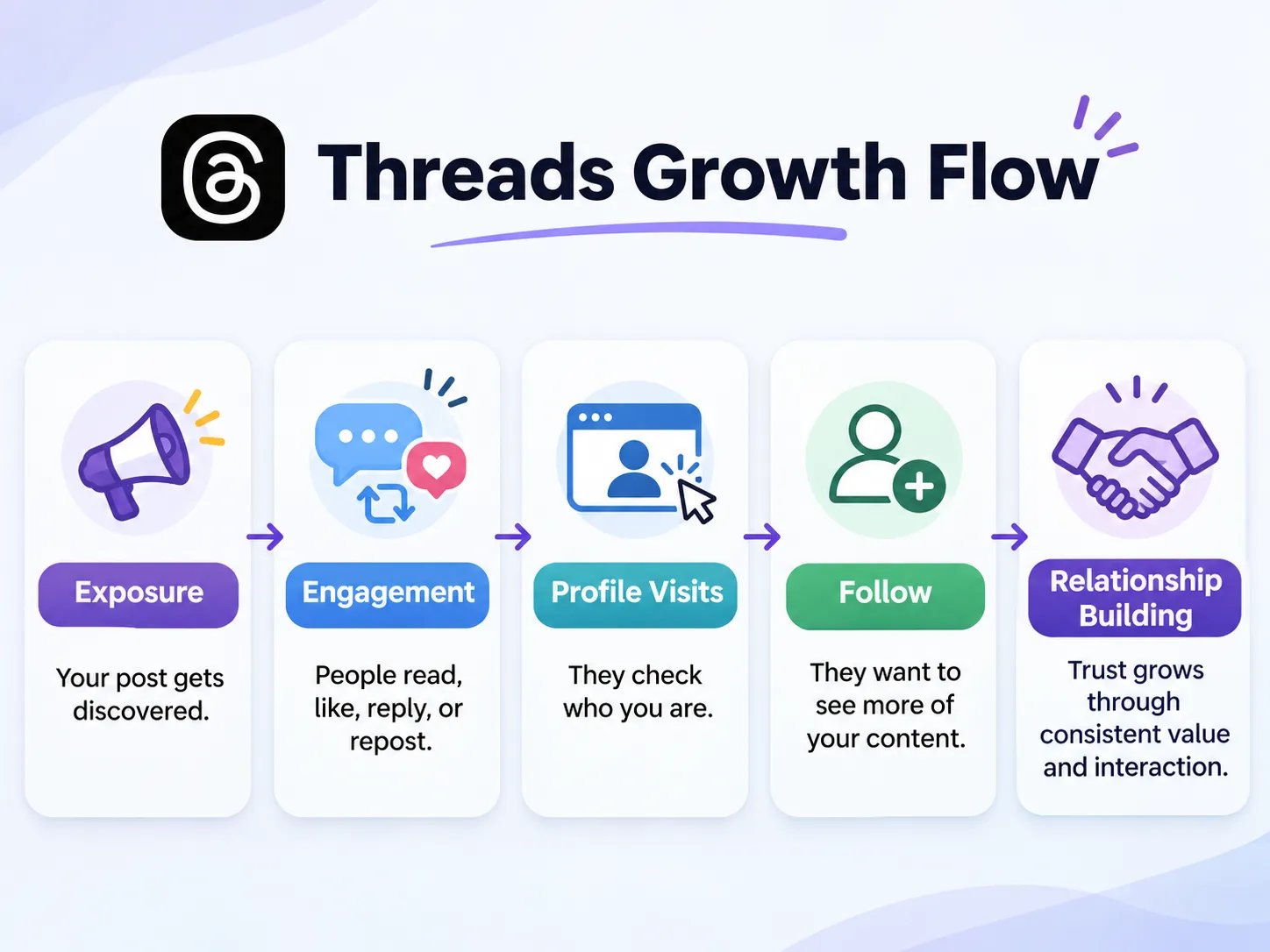
Growing a Threads account can be understood as a series of stages:14
15
**Exposure → Engagement → Profile Visits → Follows → Relationship Building**16
17
Each stage represents a different part of the audience growth process.18
19
- **Exposure:** Your content reaches people who may not know you yet.20
- **Engagement:** People read, like, reply to, or repost your content.21
- **Profile Visits:** Interested readers visit your profile to learn more about you.22
- **Follows:** People decide they want to see more of your content.23
- **Relationship Building:** Consistent interactions and useful content help develop trust over time.24
25
A post with thousands of views does not necessarily generate hundreds of followers.26
27
A viral post may attract temporary attention, while a consistent stream of relevant content gives people a reason to follow your account.28
29
The goal is not just to maximize exposure, but to attract people who are genuinely interested in what you share.30
31
32
33
34
35
## 2. Establishing Your Content Strategy and Account Identity36
37
One of the most important steps in growing an audience is defining what your account is about.38
39
When people visit your profile, they should quickly understand what kind of content they can expect.40
41
For example:42
43
- **Entrepreneurs:** Business ideas, startup experiences, failures, lessons, and growth strategies.44
- **Developers:** Technical insights, development processes, projects, and tools.45
- **Creators:** Content production, audience growth, monetization, and creative workflows.46
- **Marketers:** Marketing experiments, case studies, analytics, and practical strategies.47
48
This does not mean you must talk about only one topic.49
50
Instead, your content should revolve around a consistent identity that connects different subjects.51
52
### The 70/20/10 Content Approach53
54
A possible starting framework is:55
56
<!-- incomewiki-layout:v1:%7B%22block%22%3A%22table%22%2C%22nodes%22%3A%5B%7B%22type%22%3A%22table%22%2C%22rows%22%3A%5B%5B%7B%22type%22%3A%22tableHeader%22%2C%22colspan%22%3A1%2C%22rowspan%22%3A1%2C%22colwidth%22%3Anull%2C%22align%22%3Anull%7D%2C%7B%22type%22%3A%22tableHeader%22%2C%22colspan%22%3A1%2C%22rowspan%22%3A1%2C%22colwidth%22%3Anull%2C%22align%22%3Anull%7D%2C%7B%22type%22%3A%22tableHeader%22%2C%22colspan%22%3A1%2C%22rowspan%22%3A1%2C%22colwidth%22%3Anull%2C%22align%22%3Anull%7D%5D%2C%5B%7B%22type%22%3A%22tableCell%22%2C%22colspan%22%3A1%2C%22rowspan%22%3A1%2C%22colwidth%22%3Anull%2C%22align%22%3Anull%7D%2C%7B%22type%22%3A%22tableCell%22%2C%22colspan%22%3A1%2C%22rowspan%22%3A1%2C%22colwidth%22%3Anull%2C%22align%22%3Anull%7D%2C%7B%22type%22%3A%22tableCell%22%2C%22colspan%22%3A1%2C%22rowspan%22%3A1%2C%22colwidth%22%3Anull%2C%22align%22%3Anull%7D%5D%2C%5B%7B%22type%22%3A%22tableCell%22%2C%22colspan%22%3A1%2C%22rowspan%22%3A1%2C%22colwidth%22%3Anull%2C%22align%22%3Anull%7D%2C%7B%22type%22%3A%22tableCell%22%2C%22colspan%22%3A1%2C%22rowspan%22%3A1%2C%22colwidth%22%3Anull%2C%22align%22%3Anull%7D%2C%7B%22type%22%3A%22tableCell%22%2C%22colspan%22%3A1%2C%22rowspan%22%3A1%2C%22colwidth%22%3Anull%2C%22align%22%3Anull%7D%5D%2C%5B%7B%22type%22%3A%22tableCell%22%2C%22colspan%22%3A1%2C%22rowspan%22%3A1%2C%22colwidth%22%3Anull%2C%22align%22%3Anull%7D%2C%7B%22type%22%3A%22tableCell%22%2C%22colspan%22%3A1%2C%22rowspan%22%3A1%2C%22colwidth%22%3Anull%2C%22align%22%3Anull%7D%2C%7B%22type%22%3A%22tableCell%22%2C%22colspan%22%3A1%2C%22rowspan%22%3A1%2C%22colwidth%22%3Anull%2C%22align%22%3Anull%7D%5D%5D%2C%22index%22%3A0%7D%5D%7D -->57
58
59
| Content Type | Ratio | Examples |60
| ------------------------ | ----- | -------------------------------------------------------- |61
| Core Topics | 70% | Educational content, tips, guides, and insights |62
| Experiences and Progress | 20% | Achievements, failures, experiments, and lessons learned |63
| Personal Stories | 10% | Daily experiences, reflections, and conversations |64
65
66
For example, an entrepreneur might primarily share business insights while occasionally discussing personal challenges or daily experiences.67
68
These percentages are not official Threads algorithm recommendations. They are simply a framework that can help maintain a consistent content direction.69
70
The best balance depends on your audience, goals, and content performance.71
72
## 3. Writing Better Hooks: The First Sentence Matters73
74
Threads users scroll through a continuous feed of short posts.75
76
This makes the opening sentence especially important.77
78
A strong opening, often called a *hook*, gives readers a reason to stop scrolling and continue reading.79
80
Here are five approaches.81
82
### 3.1 Contrarian Hooks83
84
Challenge a common assumption or introduce an unexpected perspective.85
86
**Example:**87
88
> I started a business and learned something unexpected: building the product was easier than getting people to notice it.89
90
Contrarian hooks work best when they introduce a genuine insight rather than creating controversy for attention.91
92
### 3.2 Number-Based Hooks93
94
Use specific numbers, periods, or measurable outcomes.95
96
**Example:**97
98
> 5 lessons I learned from spending 3 months building a SaaS product alone.99
100
Numbers can make a topic feel more concrete and help readers understand what to expect.101
102
However, they should reflect real experiences or verifiable information rather than invented results.103
104
### 3.3 Problem-Focused Hooks105
106
Highlight a problem your target audience might recognize.107
108
**Example:**109
110
> What's the biggest mistake solo founders make when building their first SaaS?111
112
This approach works particularly well for educational posts that offer practical solutions.113
114
### 3.4 Personal Experience Hooks115
116
Start with something you have personally experienced.117
118
**Example:**119
120
> When I started building my first business, I thought a good product would naturally attract users. I was wrong.121
122
Personal stories can make content more relatable and distinguish it from generic advice.123
124
### 3.5 Question-Based Hooks125
126
Invite people to share their own experiences or opinions.127
128
**Example:**129
130
> What's the hardest part of running a business alone: building, marketing, or staying consistent?131
132
Questions can encourage discussion when they are relevant to the interests of your audience.133
134
**The main principle is simple: give people a clear reason to keep reading.**135
136
A good hook creates interest without making misleading promises.137
138
## 4. Content Types That Encourage Engagement139
140
Different content formats can attract different kinds of attention.141
142
Understanding these formats helps create a more balanced content strategy.143
144
### 4.1 Educational Content145
146
Educational posts share information that readers can apply.147
148
Examples include:149
150
- Step-by-step tutorials151
- Useful tools and resources152
- Practical marketing techniques153
- Business frameworks154
- Common mistakes and solutions155
156
The most useful educational content helps readers solve a specific problem.157
158
### 4.2 Personal Experiences and Lessons159
160
Sharing your journey can make your content more distinctive.161
162
Successful outcomes can be inspiring, but failures and unexpected problems can be equally valuable.163
164
A useful structure is:165
166
**What I tried → What happened → What I learned**167
168
For example, instead of simply saying that marketing is difficult, explain which marketing methods you tried and what results you observed.169
170
Specific experiences often provide more value than general statements.171
172
### 4.3 Opinion-Based Content173
174
Sharing personal perspectives can encourage discussion.175
176
You might discuss:177
178
- Whether subscription-based SaaS is better than one-time purchases179
- The advantages and disadvantages of building with AI180
- Common misconceptions about entrepreneurship181
- Different approaches to finding early customers182
183
Opinions do not need to be universally accepted.184
185
However, explaining the reasoning behind your perspective makes the discussion more meaningful.186
187
### 4.4 Conversation and Question Posts188
189
Some posts are designed primarily to encourage discussion.190
191
For example:192
193
> Solo founders: how did you find your first customer?194
195
A relevant question can attract people with similar interests and create opportunities for genuine conversations.196
197
Avoid asking questions purely to generate artificial engagement.198
199
The best conversations provide value to both the author and the participants.200
201
## 5. Using Comments to Build Your Audience202
203
Publishing your own posts is only one part of growing on Threads.204
205
Participating in conversations on other people's posts can also help new readers discover your account.206
207
More importantly, it helps you build relationships within your area of interest.208
209
### A Practical Comment Strategy210
211
1. Find accounts that regularly discuss topics relevant to your audience.212
2. Read their posts carefully before responding.213
3. Share a useful opinion, experience, or additional insight.214
4. Ask thoughtful follow-up questions when appropriate.215
5. Continue conversations and build relationships over time.216
217
For example, imagine someone announces the launch of a new SaaS product.218
219
A generic response might be:220
221
> Great product! Good luck!222
223
A more meaningful response might be:224
225
> Congrats on the launch! I'm building a product too, and finding early users has been challenging. How did you find your first customers?226
227
The second response introduces a shared experience and creates an opportunity for conversation.228
229
### Focus on Meaningful Engagement230
231
Repeated generic comments, aggressive self-promotion, and follow-for-follow requests may increase activity without creating a genuinely interested audience.232
233
Instead, focus on conversations with people who share your interests or could benefit from your content.234
235
**A small network of meaningful connections can be more valuable than a large audience with little interest in your work.**236
237
## 6. Optimizing Your Profile for Follower Conversion238
239
When someone discovers an interesting post, they may visit the author's profile before deciding whether to follow.240
241
Your profile should quickly answer four questions:242
243
1. Who are you?244
2. What do you do or know?245
3. What can followers expect from your content?246
4. Why should someone follow you?247
248
### Writing a Clear Bio249
250
A useful profile description typically combines identity, interests, and value.251
252
**Example for a solopreneur:**253
254
> Building businesses from scratch. Sharing startup experiments, lessons learned, and practical growth strategies.255
256
**Example for a developer:**257
258
> Building products with code and AI. Sharing development insights, experiments, and lessons from shipping real projects.259
260
Your bio does not need to exaggerate your achievements.261
262
An honest description of what you are building and learning can be compelling, especially when your audience is interested in the process.263
264
### Use Pinned Posts265
266
Pinned posts can introduce your account to new visitors.267
268
Consider pinning content that explains:269
270
- Who you are271
- What you are working on272
- What topics you regularly discuss273
- What followers can expect in the future274
275
A pinned introduction can help turn an interesting individual post into a longer-term connection.276
277
## 7. Posting Frequency and Daily Routines278
279
Consistency can help maintain audience interest and provide more opportunities to learn what works.280
281
However, posting frequently does not automatically guarantee growth.282
283
Content quality, relevance, and sustainability also matter.284
285
### Starting With 1–3 Posts per Day286
287
One possible approach is to publish one to three posts daily while testing different content types.288
289
For example:290
291
<!-- incomewiki-layout:v1:%7B%22block%22%3A%22table%22%2C%22nodes%22%3A%5B%7B%22type%22%3A%22table%22%2C%22rows%22%3A%5B%5B%7B%22type%22%3A%22tableHeader%22%2C%22colspan%22%3A1%2C%22rowspan%22%3A1%2C%22colwidth%22%3Anull%2C%22align%22%3Anull%7D%2C%7B%22type%22%3A%22tableHeader%22%2C%22colspan%22%3A1%2C%22rowspan%22%3A1%2C%22colwidth%22%3Anull%2C%22align%22%3Anull%7D%2C%7B%22type%22%3A%22tableHeader%22%2C%22colspan%22%3A1%2C%22rowspan%22%3A1%2C%22colwidth%22%3Anull%2C%22align%22%3Anull%7D%5D%2C%5B%7B%22type%22%3A%22tableCell%22%2C%22colspan%22%3A1%2C%22rowspan%22%3A1%2C%22colwidth%22%3Anull%2C%22align%22%3Anull%7D%2C%7B%22type%22%3A%22tableCell%22%2C%22colspan%22%3A1%2C%22rowspan%22%3A1%2C%22colwidth%22%3Anull%2C%22align%22%3Anull%7D%2C%7B%22type%22%3A%22tableCell%22%2C%22colspan%22%3A1%2C%22rowspan%22%3A1%2C%22colwidth%22%3Anull%2C%22align%22%3Anull%7D%5D%2C%5B%7B%22type%22%3A%22tableCell%22%2C%22colspan%22%3A1%2C%22rowspan%22%3A1%2C%22colwidth%22%3Anull%2C%22align%22%3Anull%7D%2C%7B%22type%22%3A%22tableCell%22%2C%22colspan%22%3A1%2C%22rowspan%22%3A1%2C%22colwidth%22%3Anull%2C%22align%22%3Anull%7D%2C%7B%22type%22%3A%22tableCell%22%2C%22colspan%22%3A1%2C%22rowspan%22%3A1%2C%22colwidth%22%3Anull%2C%22align%22%3Anull%7D%5D%2C%5B%7B%22type%22%3A%22tableCell%22%2C%22colspan%22%3A1%2C%22rowspan%22%3A1%2C%22colwidth%22%3Anull%2C%22align%22%3Anull%7D%2C%7B%22type%22%3A%22tableCell%22%2C%22colspan%22%3A1%2C%22rowspan%22%3A1%2C%22colwidth%22%3Anull%2C%22align%22%3Anull%7D%2C%7B%22type%22%3A%22tableCell%22%2C%22colspan%22%3A1%2C%22rowspan%22%3A1%2C%22colwidth%22%3Anull%2C%22align%22%3Anull%7D%5D%5D%2C%22index%22%3A0%7D%5D%7D -->292
293
294
| Time | Content Type | Purpose |295
| --------- | ---------------------------------------- | -------------------------------- |296
| Morning | Personal experiences or reflections | Build familiarity and connection |297
| Afternoon | Questions, opinions, or discussions | Encourage engagement |298
| Evening | Educational content or detailed insights | Demonstrate value and expertise |299
300
301
These time slots are examples, not universally optimal posting times.302
303
The ideal schedule depends on when your audience is active and how your content performs.304
305
### A Simple Daily Routine306
307
An example 60-minute routine:308
309
- **10 minutes:** Publish or prepare content.310
- **20 minutes:** Respond to comments and ongoing conversations.311
- **30 minutes:** Read and meaningfully engage with relevant accounts.312
313
This routine can be adjusted based on your available time.314
315
A sustainable schedule is generally more useful than an aggressive routine that becomes difficult to maintain.316
317
## 8. Measuring Growth and Improving Your Strategy318
319
Follower count is an important metric, but it does not tell the whole story.320
321
Depending on your goals, you may want to measure several different indicators.322
323
<!-- incomewiki-layout:v1:%7B%22block%22%3A%22table%22%2C%22nodes%22%3A%5B%7B%22type%22%3A%22table%22%2C%22rows%22%3A%5B%5B%7B%22type%22%3A%22tableHeader%22%2C%22colspan%22%3A1%2C%22rowspan%22%3A1%2C%22colwidth%22%3Anull%2C%22align%22%3Anull%7D%2C%7B%22type%22%3A%22tableHeader%22%2C%22colspan%22%3A1%2C%22rowspan%22%3A1%2C%22colwidth%22%3Anull%2C%22align%22%3Anull%7D%5D%2C%5B%7B%22type%22%3A%22tableCell%22%2C%22colspan%22%3A1%2C%22rowspan%22%3A1%2C%22colwidth%22%3Anull%2C%22align%22%3Anull%7D%2C%7B%22type%22%3A%22tableCell%22%2C%22colspan%22%3A1%2C%22rowspan%22%3A1%2C%22colwidth%22%3Anull%2C%22align%22%3Anull%7D%5D%2C%5B%7B%22type%22%3A%22tableCell%22%2C%22colspan%22%3A1%2C%22rowspan%22%3A1%2C%22colwidth%22%3Anull%2C%22align%22%3Anull%7D%2C%7B%22type%22%3A%22tableCell%22%2C%22colspan%22%3A1%2C%22rowspan%22%3A1%2C%22colwidth%22%3Anull%2C%22align%22%3Anull%7D%5D%2C%5B%7B%22type%22%3A%22tableCell%22%2C%22colspan%22%3A1%2C%22rowspan%22%3A1%2C%22colwidth%22%3Anull%2C%22align%22%3Anull%7D%2C%7B%22type%22%3A%22tableCell%22%2C%22colspan%22%3A1%2C%22rowspan%22%3A1%2C%22colwidth%22%3Anull%2C%22align%22%3Anull%7D%5D%2C%5B%7B%22type%22%3A%22tableCell%22%2C%22colspan%22%3A1%2C%22rowspan%22%3A1%2C%22colwidth%22%3Anull%2C%22align%22%3Anull%7D%2C%7B%22type%22%3A%22tableCell%22%2C%22colspan%22%3A1%2C%22rowspan%22%3A1%2C%22colwidth%22%3Anull%2C%22align%22%3Anull%7D%5D%2C%5B%7B%22type%22%3A%22tableCell%22%2C%22colspan%22%3A1%2C%22rowspan%22%3A1%2C%22colwidth%22%3Anull%2C%22align%22%3Anull%7D%2C%7B%22type%22%3A%22tableCell%22%2C%22colspan%22%3A1%2C%22rowspan%22%3A1%2C%22colwidth%22%3Anull%2C%22align%22%3Anull%7D%5D%2C%5B%7B%22type%22%3A%22tableCell%22%2C%22colspan%22%3A1%2C%22rowspan%22%3A1%2C%22colwidth%22%3Anull%2C%22align%22%3Anull%7D%2C%7B%22type%22%3A%22tableCell%22%2C%22colspan%22%3A1%2C%22rowspan%22%3A1%2C%22colwidth%22%3Anull%2C%22align%22%3Anull%7D%5D%5D%2C%22index%22%3A0%7D%5D%7D -->324
325
326
| Metric | What It Measures |327
| --------------------------- | ------------------------------------------------- |328
| Post Views | How widely your content is being seen |329
| Likes, Replies, and Reposts | How people interact with your content |330
| Profile Visits | Interest in learning more about you |331
| Follower Growth | Changes in your ongoing audience |332
| Link Clicks | Traffic directed to external websites |333
| Signups and Conversions | Business outcomes generated through your audience |334
335
336
For creators, engagement and audience growth may be primary goals.337
338
For entrepreneurs, website visits, product signups, and customer relationships can be equally important.339
340
### Analyzing Successful Posts341
342
When a post performs well, consider:343
344
- What was the topic?345
- How was the opening sentence written?346
- Was it educational, personal, or opinion-based?347
- Did readers ask questions or share experiences?348
- Did it attract the kind of audience you want?349
350
You can then revisit successful topics from different angles.351
352
For example, a post about finding early customers could become a series about outreach methods, failures, experiments, and practical lessons.353
354
### Avoid Confusing Correlation With Causation355
356
Suppose you publish a marketing post and gain 20 followers that day.357
358
The increase may be related to the post, but it could also reflect earlier content, profile visits, other conversations, or unrelated exposure.359
360
Tracking publishing activity alongside performance helps identify patterns, but it does not automatically establish what caused the growth.361
362
This distinction is especially important when evaluating marketing experiments.363
364
## 9. My Perspective: Meaningful Connections Matter More Than Follower Counts365
366
*The following section reflects the author's personal perspective.*367
368
I believe the most valuable part of growing a social media audience is not simply increasing follower numbers.369
370
It is connecting with people who genuinely care about the topics you discuss.371
372
This is especially important for entrepreneurs and solopreneurs.373
374
An account might have thousands of followers, but if those people have little interest in the business or product being developed, the audience may contribute very little to actual business growth.375
376
On the other hand, a smaller audience consisting of founders, potential customers, creators, and people facing similar challenges may lead to more meaningful opportunities.377
378
For that reason, I think social media growth should be evaluated using more than just views and followers.379
380
It is also worth considering:381
382
- Who is engaging with your content?383
- Are you building relationships with relevant people?384
- Are conversations leading to useful feedback?385
- Are people becoming interested in your projects or products?386
- Is your audience helping you learn, improve, or discover new opportunities?387
388
For someone building a business, meaningful relationships may ultimately matter more than vanity metrics.389
390
## 10. Key Takeaways391
392
Growing on Threads requires more than posting frequently or chasing viral content.393
394
A practical growth strategy includes:395
396
1. **Define your identity.** Make it clear what your account is about.397
2. **Write stronger hooks.** Give readers a reason to stop scrolling.398
3. **Share useful content.** Combine practical knowledge with real experiences.399
4. **Participate in conversations.** Engage with relevant communities.400
5. **Optimize your profile.** Help visitors understand why they should follow.401
6. **Stay consistent.** Develop a posting routine you can maintain.402
7. **Measure meaningful results.** Track engagement, audience growth, traffic, and conversions.403
8. **Learn and improve.** Use your results to refine future content.404
405
Ultimately, growing on Threads is an ongoing process of publishing, connecting, experimenting, and improving.406
407
**Rather than focusing only on gaining more followers, focus on building an audience that finds genuine value in what you share.**