 IncomeWiki
Revision 10
The More I Vibe Code, the Worse My UI Gets
11/17/2026, 12:41:35 PM
Update business log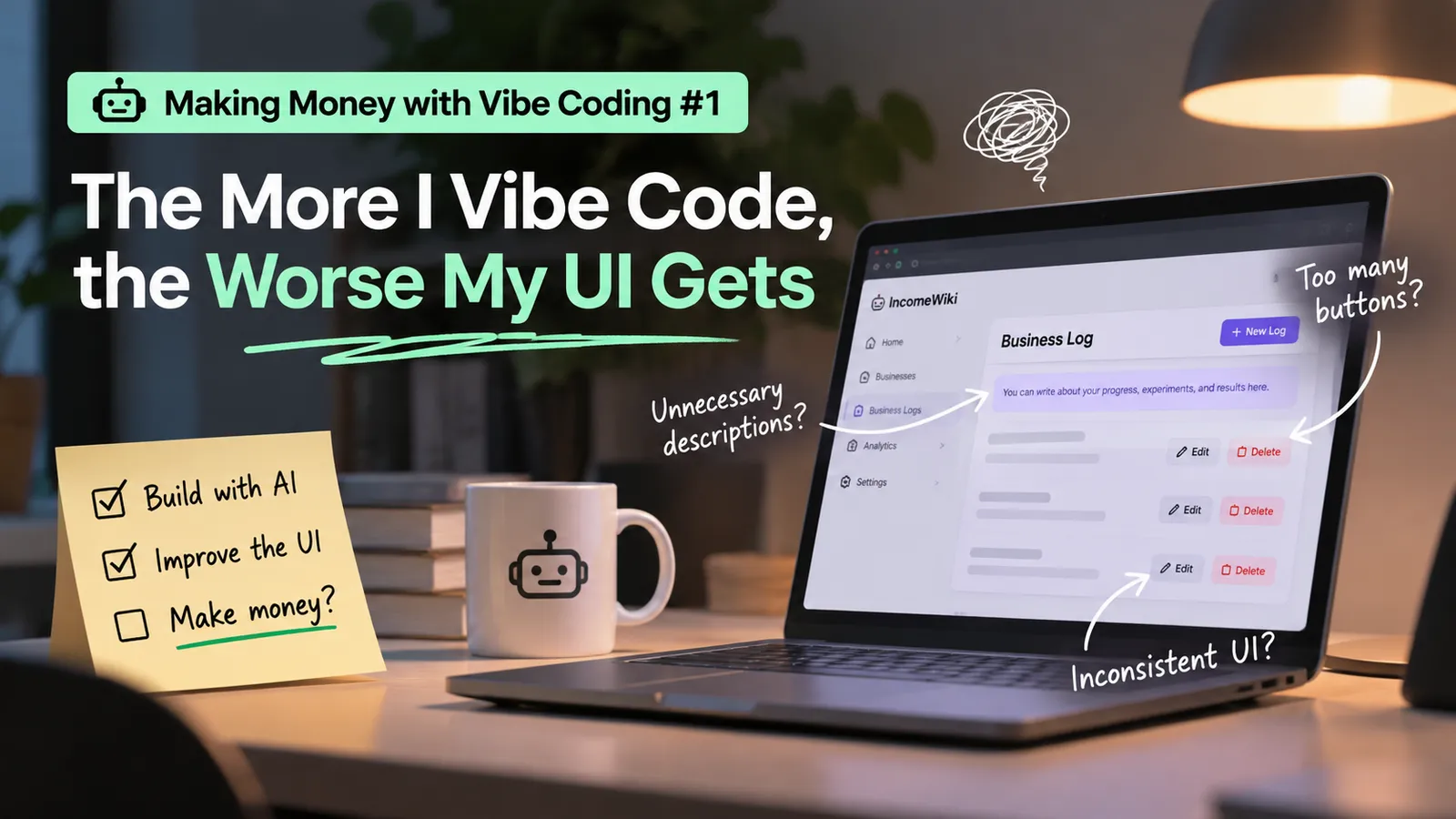
I've been building IncomeWiki, a website where founders can track business performance, document their journey, and share their progress.
Most of the development has been done through vibe coding with AI tools like Codex.
At first, it felt incredibly productive. I could build new features without writing every line of code myself.
I added business profiles, performance tracking, business logs, and integrations with Google Analytics and Search Console.
But as the website grew, I started noticing a problem.
Small explanatory texts appeared everywhere. Edit and delete buttons were scattered across different sections. Similar features had inconsistent interfaces.
Every time I asked AI to add something, it usually delivered the feature. But the overall product became increasingly complicated.
I realized that building individual features and designing a cohesive product are two very different things.
When I ask AI to build a feature, it focuses on making that feature work.
A business log needs an editor, so it creates one. A profile needs social links, so it adds another settings section. A feature needs editing controls, so more buttons appear.
Individually, these decisions might make sense. But together, they create an interface that feels cluttered and inconsistent.
The problem isn't necessarily the code itself. It's the lack of a consistent design direction across the entire product.
I've learned that AI can help me build features quickly, but I still need to decide how those features should fit together.
Instead of adding more features, I'm focusing on simplifying the existing experience.
My current priorities are:
Making business logs easier to write and organize.
Improving business and founder profiles.
Reusing shared components across the website.
Removing unnecessary buttons, descriptions, and settings.
I want the public-facing pages to focus on the content, while editing and management controls appear only when they're needed.
Canonical Markdown
 I've been building [IncomeWiki](https://incomewiki.com), a website where founders can track business performance, document their journey, and share their progress. Most of the development has been done through vibe coding with AI tools like Codex. At first, it felt incredibly productive. I could build new features without writing every line of code myself. I added business profiles, performance tracking, business logs, and integrations with Google Analytics and Search Console. But as the website grew, I started noticing a problem. ## Everything Works, But the UI Is a Mess Small explanatory texts appeared everywhere. Edit and delete buttons were scattered across different sections. Similar features had inconsistent interfaces. Every time I asked AI to add something, it usually delivered the feature. But the overall product became increasingly complicated. I realized that building individual features and designing a cohesive product are two very different things. ## Why Vibe Coding Makes UI Consistency Hard When I ask AI to build a feature, it focuses on making that feature work. A business log needs an editor, so it creates one. A profile needs social links, so it adds another settings section. A feature needs editing controls, so more buttons appear. Individually, these decisions might make sense. But together, they create an interface that feels cluttered and inconsistent. The problem isn't necessarily the code itself. It's the lack of a consistent design direction across the entire product. I've learned that AI can help me build features quickly, but I still need to decide how those features should fit together. ## What I'm Changing Now Instead of adding more features, I'm focusing on simplifying the existing experience. My current priorities are: - Making business logs easier to write and organize.- Improving business and founder profiles.- Reusing shared components across the website.- Removing unnecessary buttons, descriptions, and settings. I want the public-facing pages to focus on the content, while editing and management controls appear only when they're needed. The goal isn't to make the website look impressive with more features. It's to make the existing features easier to understand and use. ## Can a Markdown File Fix My AI-Generated UI? One thing I'm planning to try is creating a shared UI/UX guideline in Markdown. Instead of repeatedly explaining my design preferences in every prompt, I want Codex to follow a consistent set of rules. For example, my guidelines will include: - **Keep interfaces simple.** Remove unnecessary descriptions and visual clutter.- **Separate viewing from editing.** Show management controls only when needed.- **Reuse components.** Don't create different buttons, editors, or menus for the same purpose.- **Prioritize usability.** Users should understand what to do without reading long instructions.- **Design for mobile and desktop.** Check real layouts, not just whether the code builds.- **Avoid unnecessary features.** Improve existing workflows before adding more complexity. I'll put these rules in a Markdown file, such as `AGENTS.md` or `docs/ui-ux-guidelines.md`, and have Codex reference them when making UI changes. Of course, a Markdown file alone won't guarantee good design. I'll still need to review the actual pages and test the user experience. But I want to see whether consistent design instructions can make vibe coding more reliable. ## Building Features Is Easy. Building a Product Is Hard. I still think vibe coding is incredibly useful. It has allowed me to build much more than I could have built alone in the same amount of time. But I'm learning that working software isn't necessarily a well-designed product. For now, I'm going to focus on improving what I've already built rather than adding more features. I'll continue documenting the changes, mistakes, and results as I improve IncomeWiki and try to turn it into a sustainable business. **If you're building a website with AI, how do you maintain consistent UI/UX across your project?**